



 LOGIN
LOGIN


Beloved Yarrow. Its history is intertwined with human civilizations and the Earth’s ecology. From “the old English “gearwe” (which morphed to “Yarrow”) to casting its dried stalks as part of I ‘Ching divination, it has been a protective green ally spanning physical and spiritual healing over centuries and across cultures and continents. This article highlights Yarrow and its essential oil, ending with a poem I wrote about Yarrow’s qualities.
Yarrow’s Protective Nature: A Gradual Realization
I’ve asymptotically engaged with Yarrow’s protective quality over many years, always feeling blocked (looking back–that was a clue I didn’t look deeper into). Thwarted. For example: Years ago, I tried writing about Yarrow, (click here) but I knew the time wasn’t right. Yarrow came up again in 2020 and even inspired a haiku poem (click here) and Plant Talk video (here and at the end of this article). But the time still wasn’t right: I knew I was missing its deeper messages. Only recently did I realize that “blockedness” is part of its protection and neutrality—the qualities were always presenting but I was not receiving.
Yarrow: Fern-like Healer, Not Achilles’ Glory
You’ve likely come across the origin of is name Achillea millefolium: derived from the Grecian warrior Achilles, who supposedly used Yarrow to stop the bleeding of his soldiers’ wounds; Millefolium meaning “many leaves”, “a thousand leaves”. Though I’d rather describe the leaves as fern-like and call upon the wounded healer archetype to bestow Yarrow the taxonomic name of Vulnerans-medicinis filicinus rather than Achillea millefolium. Why give Achilles all of the glory? Yarrow is a plant of the people, with every person being wounded in some way with the potential to turn that wound into strength, bestowing each the power to heal and share that healing. Yarrow is the plant of the wounded healer.

Yarrow’s Temperate Strength and a Cameo Appearance by Helichrysum
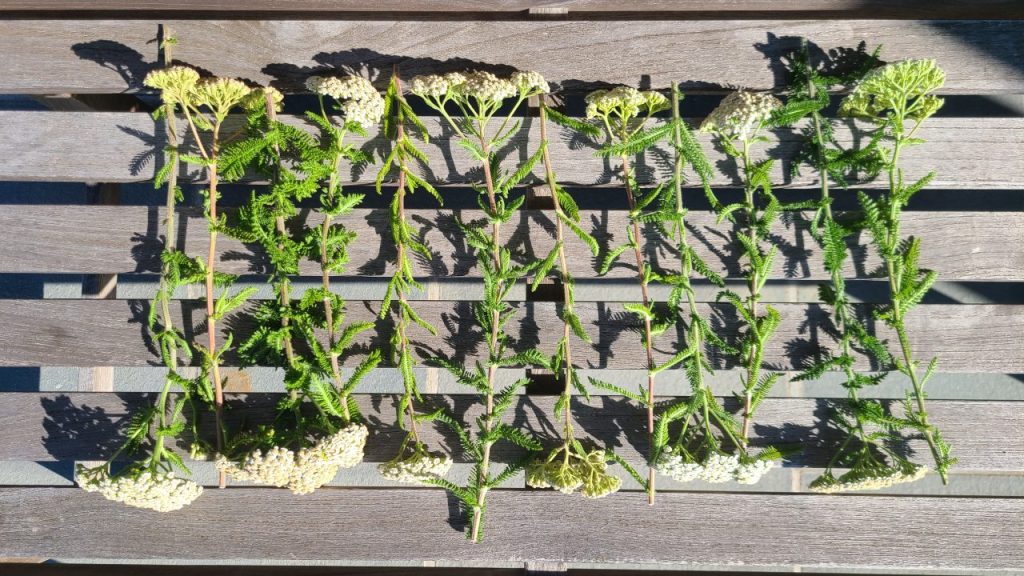
Yarrow is a resilient spreading herbaceous perennial if living in its preferred conditions. A member of the Aster/Sunflower family, it is known for its fine, feathery, fern like (filicinus!) leaves, long sturdy stems and tiny flowers arranged in composite umbels. Lately I’ve been reflecting upon the similarities (and differences) between Helichrysum (see video) and Yarrow: both in the same family, both with an affinity with blood/wounds: Yarrow targets the 3rd eye, lower abdomen and moving forward, whereas Helichrysum resonates with the solar plexus and allow one to tend to (coddle, lick) past (emotional) wounds. (Helichrysum is for when you’re not ready to move on—when the stuff is still too raw.) Yarrow thrives in temperate climates; Helichrysum has a preference for drier climates closer to the equator where Yarrow may (or may not…) perish. For instance, Yarrow gets along very well at my home on Long Island; Helichrysum on the other hand, dislikes the humidity and soil conditions.
Yarrow prefers well-drained, lean soil and sunlit areas, spreading readily by seeds and creeping rhizomes. Of note: I often find Yarrow and Lavender seedlings growing in my gravel driveway (see video below)—a fine example of its tenacity and preference for lean, unprotected areas. Conversely, it doesn’t mind a little shade (though will bloom less). Wherever it grows, it is an important part of its local ecology.
Yarrow as a Nurse Plant
Similar to German Chamomile (also in the Asteraceae family), Yarrow is considered a nurse plant, meaning it has beneficial effects on surrounding plants and general ecology. Nurse plants are known for their ability to improve the growth conditions of nearby plants, often by enhancing soil quality, providing shade, reducing evaporation, or protecting other plants from wind and pests. According to Philbrick & Gregg, it helps increase nearby plants’ vitality including other aromatic herbs’ essential oil content.
Yarrow has a relatively shallow and wide-spreading root system with rhizomes, creating a dense carpet-like growth, but it also has fibrous roots with the capacity for moderate root depth (even a foot long!) which helps it tolerate dry conditions, aerate soil and pull up minerals from the soils depths. Yarrow is known to accumulate essential minerals like copper, magnesium, nitrogen, phosphorous, and potassium from these depths, making it beneficial to the topsoil and overall ecology if left to decay and go back to the Earth.
Yarrow’s shield-like umbels attract beneficial insects such as predatory wasps, ladybugs, lacewings and hoverflies; all help control pests. And by providing some shade and protection, Yarrow can create a more favorable microclimate for seedlings and young plants.
Essential Oil of Yarrow
Yarrow’s essential oil, derived from the fresh flowering herb, contains azulenes and bitter lactones (among many other components) giving it a complex chemistry. Azulenes give the oil a blue hue; the component matricin turns to chamazulene during distillation. According to Holmes, essential oil yield is highly variable, from 250 to 1,000kg of the herb to obtain 1kg of oil. Given how Yarrow grows around the world and adapts to many environments, this wide variation in yield is not surprising. This cooling herb is indicated for conditions of heaviness, bloating, and inflammation. Yarrow tea, poultice, and essential oil provide relief and support for a variety of ailments. Following is an exploration of Yarrow essential oil’s notable qualities and applications.
Holistic Qualities of Yarrow Essential Oil
For years I resisted Yarrow’s protective quality—this kept me from exploring the plant and essential oil beyond its well-known affinity for all things bloody and wounded. Something about Yarrow’s reserved quality finally revealed itself: accepting its neutral, buffering quality opened space to reveal what needs to be moved and processed.
Yarrow’s protective nature acts like a shield, helping to block external forces and allowing buried emotions to surface. It brings clarity and a sense of detachment, making it a valuable ally during times of emotional transition. Whether you’re feeling down on yourself or the world, Yarrow offers a sense of upliftment and clear seeing. It is indicated for “down and stuck” mental and physical stuff, offering clarity, realizations, clearing physical stagnation (notably below the navel).
Yarrow energizes and dissipates, creating a pulsing and stimulating effect in distinct parts of the body. It has an affinity for the sacral/2nd chakra area, notably the uterus and benefiting digestion. Yarrow has a particular affinity for fluids such as blood, urine, and lymph, enhancing their movement and circulation in the lower part of the body.
The essential oil activates the third eye region including occipital nerves and radiates outward to the temples, promoting clarity and inward focus. This leads to a sense of detachment and calm within the mind. Stimulating & moving energy in the 3rd eye region disperses Vata like analytical qualities such as over thinking, allowing for steadiness of thought—allowing dispassionate observance.
Here’s an excerpt from my notes on Yarrow oil relating to states like “analysis paralysis”: “The shield quality protects the body/soul from the analytical mind of taking over to an extent. It amplifies the body/lower chakras to help feel with the soul/instinct self and stimulates the 6th chakra allowing for detached observation. Yarrow doesn’t care about process. It doesn’t care about details or HOW.”
The oil simultaneously moves energy downward directly to the lower abdomen and dissipates outward through the outer thighs, with a signature along the IT band. There is a light-flight quality about the movement—the pulsing of a bird’s wings gently playing along the atmosphere’s thermal waves.
This play between the 2nd chakra, quadriceps, 3rd eye (including occipital nerve) and temples suggests that Yarrow balances upward and downward energies, promoting a sense of movement and presence. It helps release built-up energy, providing a feeling of holistic (body, mind, emotions, spirit) aliveness and lightness. To summarize the physical manifested into holistic application: Yarrow brings a sense of detached observation and clarity (3rd eye center) allowing one to move forward (thighs) with creativity (sacral region).
In Summary: Yarrow for Holistic Trauma Healing and Spiritual Connection
Yarrow acts as a protective shield, both internally and externally, helping to block out negative influences and allowing buried emotions to surface safely. It promotes healing from both physical and deep emotional trauma, soothes and calms the mind and emotions, offering a sense of detachment and clarity. It balances heavy emotions and stagnant energy, providing a sense of lightness and presence, while calming overactive thoughts and promoting centered thinking. The neutral-cooling properties of Yarrow soothe inflammation, both physically and emotionally without sedating. Yarrow encourages a sense of presence and movement, balancing upward and downward energies and promoting a feeling of being grounded and alive. Additionally, it helps by activating lower chakras and enhancing intuitive seeing (3rd eye), fostering a deeper connection to one’s inner self and overall well-being.
Practical Applications of Yarrow Essential Oil
As a healer for both the land and the body, Yarrow is indicated for heaviness, stagnation, atony, despondence, down-ness (even in the garden!). According to Holmes: the essential oil is a general stimulant and decongestant; works on level of fluids water lymph blood and indicated when damp congestive stagnation is present. As noted, there’s a wealth of information available on Yarrow’s herbal and aromatherapeutic applications. Below is a brief summary of key therapeutic uses. For more detailed and specific applications, I highly recommend consulting your favorite aromatherapy references.
- Emotional Support: (As noted above in the holistic qualities) Yarrow helps alleviate feelings of being stuck and down. *Down to the brink of deep dispar: offering clear seeing and emotional balance.
- Depending on intention, blend with Cistus, Myrrh, Palmarosa, Helichrysum, Roman chamomile, Rose (and others) for supporting the processing of deep, buried emotional muck.
- *DISCLAIMER: Granted, an herb or essential oil does not substitute for professional medical care, therapy, or support when dealing with serious mental health issues such as suicidal thoughts. If you or someone you know is struggling, please seek help from a qualified healthcare professional immediately.
- Circulatory Support: Effective for hemorrhoids, varicose veins, and overall blood circulation. Affinity for lower abdomen and legs.
- Blend with: Cypress, Rosemary, Patchouli.
- Dermal Support: Aids in wound healing, scar formation, and soothing skin conditions. Indicated for Acne.
- Blend with: German Chamomile, Blue tansy, Cistus, Helichrysum, Patchouli, Myrrh, Frankincense, Niaouli or Tea Tree.
- Respiratory Support: Provides relief from congestion and supports respiratory health including potential allergy symptom relief.
- Blending allies: German Chamomile, Inula, Blue Tansy, Rosemary Cineole, Myrtle.
- Digestive Support: Eases digestive issues and promotes overall digestive health.
- Blending: Fennel, Angelica root, Mandarin, Grapefruit, Ginger, Cardamom.
- Pain Management: German/Roman chamomile, Helichrysum, Marjoram, Rosemary cineole, Frankincense (and more….)
- Feminine Reproductive Support: Uterine stimulant. Indicated for menstrual, peri and post-menopausal harmony. Indicated as Estrogen inhibitor.
- Not for use in pregnancy!
- Blending: Rosemary verbenone, Clary sage, Geranium, Angelica root, Vitex, Clary sage; even Fennel and Tarragon, depending on the intention and hormone levels.
Chemistry & Safety Notes for Yarrow Essential Oil
Not for use with babies, children or during pregnancy. This oil that is not meant for daily prolonged use given its range of variability and complex chemistry which often includes various ketones such as thujone. As noted, the variability in oil yield is related to the different growing locations and conditions, which in turn affect the chemical composition of the oil. As a protective oil for emotional/spiritual/mental applications, it’s often best used through olfaction rather than topical application, or blended with other oils and diluted into a blend as a spray/auric mist.
Blending Notes for Yarrow Essential Oil
Blending note: Earlier I brought up Helichrysum in light of Yarrow. There’s something about their aromatic chemistry—they stand apart and on their own (as do many other oils). For instance, many may smell Myrtle and be reminded or Rosemary or even a Eucalyptus. Smell certain Frankincense and you may notice Lemon. Not so with Yarrow or Helichrysum (or Cistus, Valerian, Opopanax, or…).
When blending with Yarrow (and Helichrysum), the unique chemistry may dominate the blend from an olfactory ‘like and dislike’ perspective, which is a viewpoint I encourage placing less importance on. How can one plant be more “important” or “better” than another? How can one scent molecule be considered better or more pleasing than another? My take is to remain open to the information each plant provides rather than reducing it to mere preferences of liking or disliking.
Depending on your intention Yarrow blends well with so many oils. Always remember the protective, shield, neutral quality, third eye (including occipital) and sacral/creative, moving forward (leg/quad) quality it has on the holistic level. Blending ideas are noted above in the therapeutic section.
A Poem: Yarrow
by Amy Anthony

In the cracks, among the pebbles,

By seaside and over prairie,

Gracefully adept, trampled underfoot, protective Yarrow thrives.


Attendant to coursing, rich blood, quenching wounds--

A reminder of being alive.

Blood’s absence or stasis is death’s dull reminder.


Though quiet and steadfast,

Deceptively humble, oft misread as common,

Yarrow’s umbels and feathers stand protective: a barrier from without, a neutral shield within.
Blending with Yarrow: A Protective Spray Mist
Combine the following essential oils in a 1-ounce glass bottle with fine mist spray top. Top off with distilled water or hydrosol of your choice. Shake before using. Spray your auric field—spray the air above you 3-5 times and let the mist fall upon you.
- Yarrow: 16 drops
- Eastern red cedar: 12 drops
- Sweet grass tincture: 9 drops
- Cistus: 1 drop
- Galbanum: 1 drop
- Combava peel: 2 drops
- Camphor (Cinnamomum Camphora Wood): 2 drops
Learn how to make your own aromatherapy spray-mists in this video-based class.
Yarrow Plant Talk Video (June 2020)
Works Cited:
Philbrick, Helen, and Richard Gregg. Companion Plants and how to use them Old Greenwich , CT. 1990.
Holmes, Peter. Aromatica: A Clinical Guide to Essential Oil Therapeutics, Volume 2: Applications and Profiles. Singing Dragon, 2019.
Leave a Reply