



 LOGIN
LOGIN
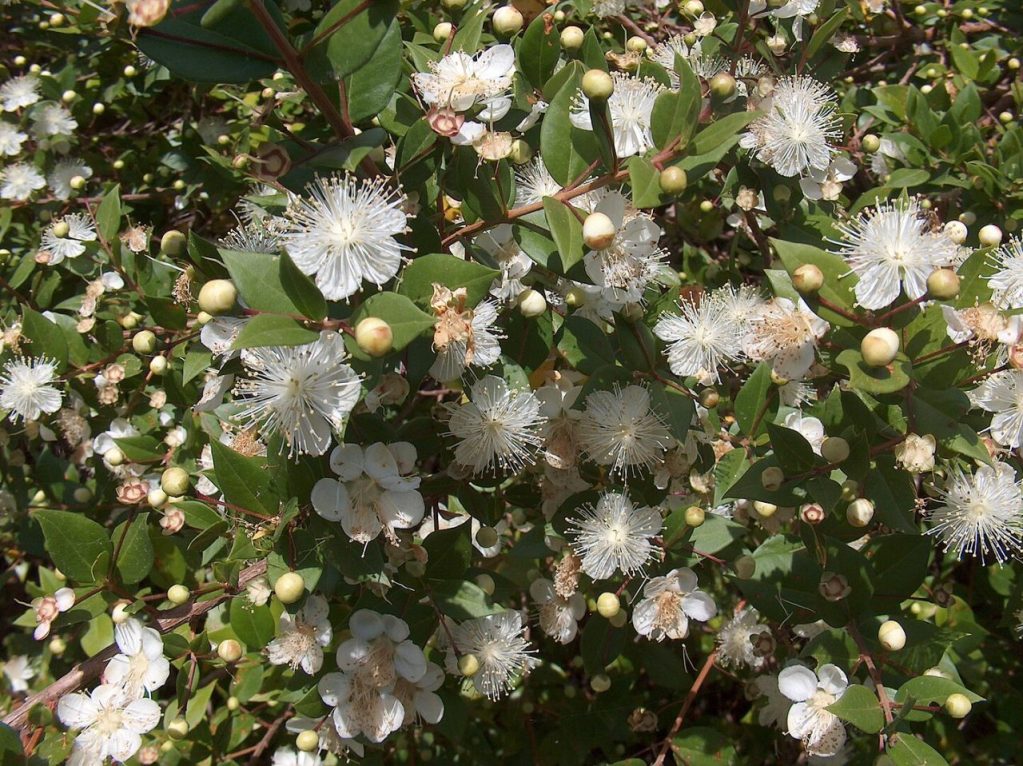
Grace, demure, gentle, alluring, joyful. Who’s that about? Of course I’m describing Green Myrtle’s essence! Just looking at Myrtle’s flowers may spark immense joy and coax bright smiles! Notice how its flower’s stamens delicately fluff out like fireworks! Sure, Myrtle may seem showy at first glance, but it doesn’t show off or act bossy or brash. There’s something to say about that. A lot, actually. That’s why this Plant Talk article and video are here; to highlight Myrtle’s personality, focusing on its essential oil. Topics of note: aroma-therapeutic applications, blending notes and incorporating Myrtle essential oil into wellness-supporting aromatherapy applications.
Pleased to Meet You, Myrtle!
Welcome to the enchanting world of Myrtle! The plant is so fabulous that the early botanists named an entire botanical family, Myrtaceae, named after it! The Myrtaceae family contains several aromatics of global renown such as the Melaleuca and Eucalyptus genera. Myrtle, with its small green leaves and white flowers which are the precursor to purplish-black fruits, is native to the Mediterranean basin: from Spain to Morocco to Turkey and the Middle East.
Why Green Myrtle vs. Simply, Myrtle?
You may notice this article is about “Green” Myrtle. What’s that all about? There’s also a “Red” Myrtle essential oil on the market. They are both from Myrtus communis; the difference is in the chemistry. Like any other living being, self-expression or presentation (phenotype) has a LOT to do with climate and geography. Of interest, most “Green” Myrtle comes from locations “north-ish” of the Mediterranean Sea and “Red” Myrtle comes from locations more “south-ish” of the Mediterranean Sea. I vividly recall a Myrtle I had a few years ago that was from Albania and quite dark in color—its overall aroma was quite woody. “Red” Myrtle generally is higher in esters whereas “Northern” may be higher in alpha-pinene and 1,8 cineole. My unsolicited advice is to appreciate each chemo-type for its respective personality and virtue. Regardless, both types excel at supporting respiratory health, are sweet, relaxing and beneficial for our skin among other virtues.
Myrtle: Green Vitality Through Grace and Peace
Myrtle is an ancient plant with several references found in the Bible and classical mythology. The plant was sacred to Aphrodite and Venus; representing beauty, youth and love. Not passionate, sexual love but genuine, elevated and authentic love which goes beyond rapture and emotions. Every time I smell Green Myrtle—regardless of which geography it came from—there is a quiet vitality about it. Its aroma evokes grace, rejuvenation & peace. Holmes writes how Myrtle embodies “authentic expression,” and I concur. Being with Green Myrtle is like when you’re “in the zone” because of pure love of what you are doing versus taking a stimulant of some sort. The plant and its aromatic oil give vigor and celebrate courage but not valor like Laurus nobilis. Reflecting on this, Myrtle used to be given to poets, woven into garlands for athletes and represented victory from a bloodless battle (Blakely, 2018). Myrtle embodies the yin energy in the equation of the whole, whereas Laurel embodies the yang.

Impressions of Green Myrtle Essential Oil
Join me in the garden with Green Myrtle and its essential oil. Look forward to the poetry of Robert Hass (A Supple Wreath of Myrtle) and Mary Elizabeth Coleridge (Jealousy).
Obtaining Green Myrtle Essential Oil
Green myrtle essential oil is distilled from the fresh leaves of the evergreen shrub botanists call Myrtus communis (a.k.a., True Myrtle). The plant is often grown and distilled for its essential oil in France, Corsica, Spain, Italy, Morocco, Algeria, Tunisia, Lebanon and Albania. Yield-wise, it takes approximately 120-170 kgs of fresh leaves to obtain 1 kg of essential oil according to Holmes.
Green Myrtle Essential Oil Personality
Green Myrtle brings an immediate rush of oxygen and rejuvenation in a refined, gentle, graceful way. It communicates that there is no rush. None at all. Myrtle takes its time to work through the mind and body. Its qualities sing of sustainment and vitality versus “getting rid of things.” Its mildly stimulating quality brings overall decongesting—it clarifies the soul so we may better access the grace within us.
What does Green Myrtle Essential Oil Smell Like?
Green Myrtle’s initial sensation is brisk and cool mixed with refreshing verdantly green air. Expansive space is created but not aggressively. Myrtle is like the lapping of a gentle sea’s tide versus a wild and brash ocean’s crash. A mantle of sweet, serene vitality is placed upon your shoulders. Pine notes are dominating at first, giving way to lilac and heart-wood. Primavera: where pine meets sweet Laurel with a backbone of an old, musty Victorian library with layers of velvet. The cooling dissipates, leaving warm, floral-herbaceous hints of peach, clove and licorice. Yet the whole olfactory experience, though invigorating, is quieting and exemplary of refinement, grace and elegance.
Green Myrtle Essential Oil Affinities and Usage Applications
Green myrtle essential oil has an overall decongesting quality with an affinity for the respiratory tract as well as the skin and venous system. It is uplifting yet calming on the nerves and may encourage states of clarity and inner peace. Following are notable therapeutic actions and indications where Green Myrtle essential oil may be worked with:
- Emotional support: indicated for stuck, bogged down qualities. Myrtle is uplifting, calming, quieting, regulating, tonifying.
- Circulatory/Cardiovascular support: Venous decongestant, stagnation, poor circulation, hemorrhoids, varicose veins.
- Dermal support: Revitalizing tonic, psoriasis, irritated skin, devitalized skin (e.g., smokers’ skin, lack of circulation).
- Respiratory support: Infections (overall ENT), anti-infectious, antimicrobial, congestion with mucus, catarrh in general, sinusitis, general afflictions of the upper and lower respiratory tract (e.g., colds, flu, bronchitis).
- Urinary support: due to its anti-infections and antimicrobial nature myrtle tea was drunk for infections—a sitz bath with the essential oil or hydrosol may benefit cystitis, urethritis & prostatitis.
Blending with Green Myrtle Essential Oil
The following essential oils support Green Myrtle in the indications and applications noted above. I would turn to Frankincense, Elemi, Laurel and Rosemary for mental clarity. Saro, Cistus and Manuka leaf come in for deep emotional support (processing trauma, stuck patterns). Most of the below oils support overall health and respiratory support.
Frankincense (Boswellia carterii), Elemi (Canarium luzonicum), Thyme ct. linalool (Thymus vulgaris ct. linalool), Rosemary ct. cineole (Rosmarinus officinalis/Salvia rosmarinus ct. cineole), Eucalyptus species (i.e., Eucalyptus citriodora, E. globulus, E. radiata), Manuka (Leptospermum scoparium), Niaouli (Melaleuca quinquenervia), Saro (Cinnamosma fragrans), Ravintsara (Cinnamomum camphora), Laurel (Laurus nobilis), Cistus (Cistus ladaniferus) and Spike lavender (Lavandula latifolia).
Notes on Green Myrtle Essential Oil Chemistry and Safety
Green Myrtle essential oil is rich in the ether 1,8 cineole, monoterpenes (specifically a-pinene) and supported by several esters, where myrtenyl acetate is often the most abundant. Trace amounts of phenylpropenoids (e.g., methyl eugenol) are found in the oils reminding us it is related to Clove. However—and noted above—Myrtus communis’ composition greatly varies depending upon the location/climate/elevation it calls home. To that end, it is my understanding that recognized chemotypes of Myrtus communis are defined by 1,8 cineole in relation to myrtenyl acetate in relation to alpha-pinene.
Green myrtle is considered safe for dermal, olfactory and respiratory use. However, it is wise to observe the general guidelines around an essential oil rich in 1,8 cineole (again, this is where the chemo-type business comes in): Avoid applying near the nostrils of infants due to risk of spasm of the glottis, due to the cooling effect on the respiratory system. Do not apply to or near the face of infants or children. Use caution and low dilutions when applying essential oils rich in 1,8 cineole to children under the age of 5 (five) years old (Tisserand R, 2014). However, I have found this oil quite calming and gentle and have used it, mindfully diluted, in respiratory salves for young children.
Making Aromatherapy Products with Green Myrtle Essential Oil
Dermal Health: Revitalizing Skin Care
I love making my own face and body oils, especially during the yin part of the year. And Myrtle is a yin plant! My skin is happier in the summer months with a light cream product but come the fall and winter months my skin doesn’t mind a little help to work with the lack of moisture and the cold. The fixed oils nourish skin, and the essential oils support immunity and vitality (and stress levels!) through-and-through.
- 5 drops Myrtle (Myrtus communis)
- 4 drops Frankincense (Boswellia carterii)
- 2 drops Manuka (Leptospermum scoparium)
- 2 drops Vetiver (Chrysopogon zizanioides)
- 1 drop Cistus (Cistus ladaniferus)
Directions and usage suggestions: First, blend the aforementioned essential oils in a 1-ounce glass bottle with a dropper top and let them sit a few days to even out. Then, add your chosen fixed oils to the bottle. I’ve used the following: Rice bran (18ml), Carrot seed (5ml), Pomegranate seed (5ml), Borage seed CO2 (2ml) and Evening primrose CO2 (2ml). Honestly, a simple blend of Jojoba (27ml) and Rosehip seed (3ml) would be quite simple yet effective but I’m guilty of loving many nut and seed oils!
Usage-wise, I enjoy applying this oil 1x/day after washing my face and have been quite satisfied with the emotional and physical impact over the years.
Stimulating and Clarifying Blend for Scalp and Mind
- 3 drops Green Myrtle (Myrtus communis)
- 2 drops Rosemary verbenone (Rosmarinus officinalis/Salvia rosmarinus ct verbenone)
- 1 drop Laurel leaf (Laurus nobilis)
- 1 drops Carrot seed (Daucus carota)
- 1 drop Sage (Salvia officinalis)
Usage suggestion: Scale up to 3% dilution for a scalp oil. Swap out Carrot seed for Elemi or Frankincense and Rosemary Verbenone for the Cineole chemotype for smell and memory training.
Respiratory Support Salve for the Family
I’ve made the following salve to help a client support her family’s immunity during the cold months with great efficacy. The overall combination offers gentle respiratory support and immune enhancement. Smell the following essential oils to appreciate the aroma and tweak the blend by swapping out some of the essential oils with a few of the ones suggested below depending on your intention.
- 9 drops Corkbark Fir (Abies lasiocarpa variety arizonica)
- 8 drops Frankincense (Boswellia carterii)
- 8 drops Rosalina (Melaleuca ericifolia)
- 7 drops Green Myrtle (Myrtus communis)
- 5 Cape Chamomile (Eriocephalus punctulatus)
- 0.3 ounces of beeswax
- 1.7 ounces of Calendula herbal infused oil (e.g., Calendula in Sunflower))
Other oils to consider: Saro (Cinnamosma fragrans), Spike Lavender (Lavandula latifolia) and Black Spruce (Picea mariana).
Making the Salve: Combine the essential oils in the 2-ounce container and affix the cap. Melt down the beeswax using a double boiler, stirring in the Calendula infused oil to incorporate. (Click here to learn more about salve making.) Remove from the heat and add the wax mixture directly to the jar with the essential oils. Stir well to incorporate the essential oils. Affix the cap and apply a label with a name that centers on the intention behind the salve, and list the ingredients and note the date.
In Closing: Strength in Peace and Grace
Myrtle helps us in a gentle yet powerful way. It is a demure plant (those flowers!!!) of great efficacy without being overly forceful. It is exemplary of how it does not always take forceful plants like Cinnamon, Oregano or Eucalyptus globulus to get the job done. Thank you for spending time with Green Myrtle and me.
Sources of Note:
Blakely, J. (2018, June 28). Myrtle: The Provenance and Meaning of a Plant. Retrieved from Unbound Smithsonian Libraries: https://blog.library.si.edu/blog/2018/06/28/myrtle-the-provenance-and-meaning-of-a-plant/#.XdW3muhKiUm
Holmes, P. (2019). Aromatica A Clinical Guide to Essential Oil Therapeutics (Vol. II). London: Singing Dragon.
Schnaubelt, K. (1998). Advanced Aromatherapy. Rochester: Healing Arts Press.
Tisserand R, Y. R. (2014). Essential Oil Safety Second Edition. Edinburgh: Elsevier.
Verica Aleksic, P. K. (2014). Antimicrobial and antioxidative activity of extracts and essential oils. Microbiological Research, 240-254.
Leave a Reply