



 LOGIN
LOGIN

Cedar’s Medicine for a Deep Winter Season
Deep winter has a way of slowing everything down — the body, the mind, the pace of life. This year, I’ve been living inside that deep‑yin stillness more than usual. The death of our beloved dog Nikki, an urgent health diagnosis for someone close to my heart, and other life shifts have brought me into a quieter, more interior place.
During this time, Atlas Cedar essential oil (Cedrus atlantica) has been a steady companion. Not for stimulation or uplift, but for containment — the warm, protective yang that allows yin to rest without collapsing. Cedar has been helping me hold what needs holding, process what needs processing, and stay grounded in the middle of winter’s (literal and figurative) emotional and energetic demands.
If you’ve been feeling the pull inward, or navigating your own inner winter, Cedar may be a supportive ally for you too.
Ecology and Botanical Identity of Atlas Cedar (Cedrus atlantica)
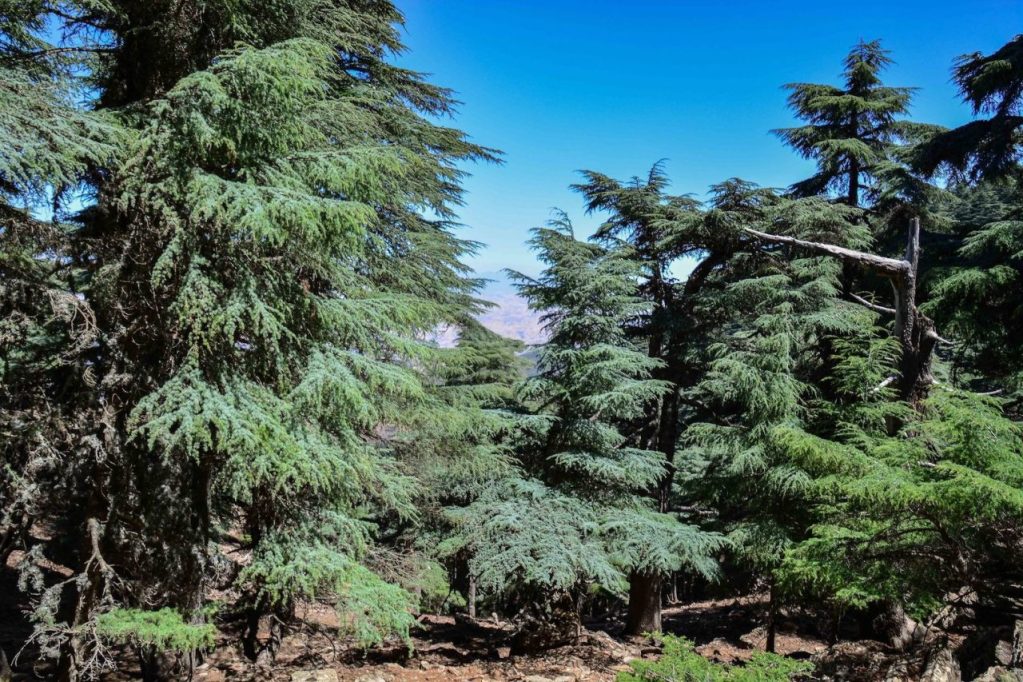
Atlas Cedar is native to the mountains of Morocco and Algeria, growing primarily in the Rif, Middle Atlas, High Atlas, and Tell Atlas ranges. These are high‑elevation Mediterranean mountain climates with cold, often snowy winters, dry summers, and rocky, well‑drained soils.
This adapted to high altitude extremes — steady, long‑lived, and resilient. Mature Atlas Cedars can reach 40 meters (about 130 feet), forming expansive crowns. Some can live to be hundreds of years old.
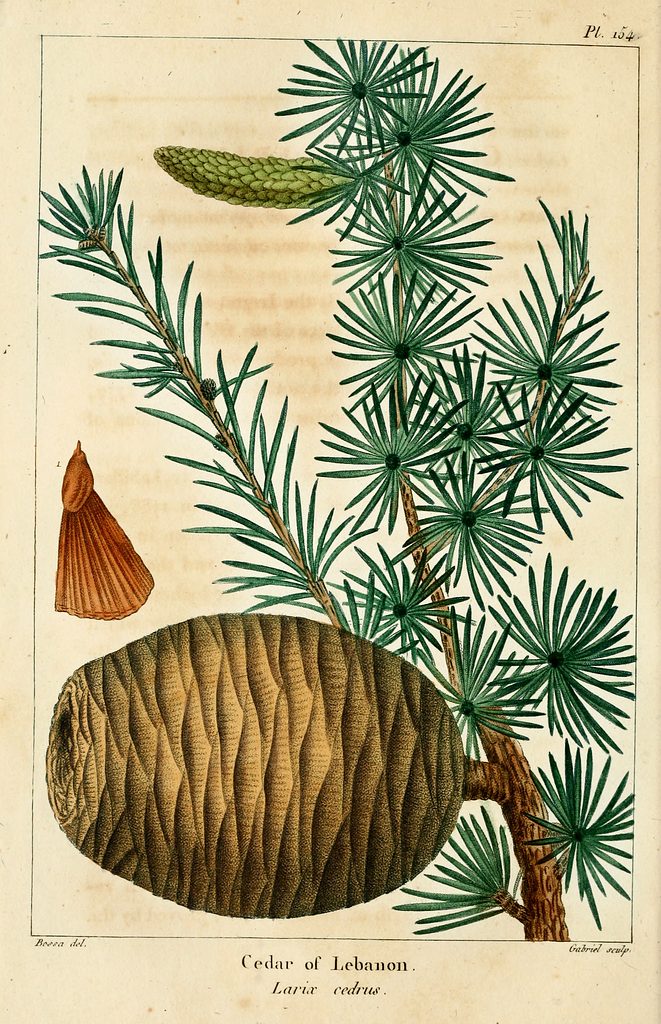
Botanically, Atlas Cedar is closely related to Lebanon Cedar and was once considered a subspecies (Cedrus libani subsp. atlantica). Today, most botanists recognize it as its own species.
Conservation Status and Responsible Use
In aromatherapy, the essential oil is obtained by steam distillation of the wood, especially the heartwood. The yield is relatively high (3–5%), but it comes at the cost of felling trees — a reminder to work with Cedar respectfully and sparingly. Due to over‑harvesting and habitat loss, Atlas Cedar (Cedrus atlantica) is now classified as Endangered (Cedrus atlantica, n.d.). For this reason, its essential oil is best reserved for short term application of deep emotional work — crisis, grief, dis‑harmonized emotional states — rather than routine physiological or cosmetic applications. When you need a more sustainable option, there are excellent aromatic analogues. This is the great thing about aromatherapy—there are always other aromatic plants to turn to.
Aromatic Analogues and Related Species
For those seeking sustainable alternatives, Cedar has several important aromatic analogues. If you don’t have Cedrus atlantica — or if you’re choosing to conserve it due to its endangered status — you can work with Himalayan Cedar (Cedrus deodara) or Virginian Cedarwood (Juniperus virginiana), a North American species often called “Red Cedar.” While these trees are not botanically interchangeable, they share overlapping aromatic qualities and energetic signatures. Turning to these analogues’ honors both ecological responsibility and the global nature of aromatic medicine, reminding us that supportive plant allies grow close to home as well as across the world.
The Essence of Atlas Cedar
Atlas Cedar carries the presence of a steady guardian — warm, protective, quietly watchful. It offers containment rather than stimulation, creating the inner shelter where deep rest and repair can finally happen. Cedar says, “You don’t have to hold anything for me. I’m the one holding you.” It supports the psyche in states of overwhelm, freeze, or depletion by offering boundary, steadiness, and emotional safety. Rather than doing or energizing, Cedar promotes stillness within; it allows the deep, hidden reserves of vitality to settle, gather, and strengthen. When life feels heavy, porous, or too exposed, Cedar stands at the perimeter so your inner world can breathe again.
Aromatic Profile of Atlas Cedar Essential Oil
Atlas Cedar essential oil is warm, dry, woody, and slightly resinous. Soft, yellow, and quietly tenacious (it’s a natural fixative), it has depth without heaviness and subtlety without weakness. It doesn’t shout: its chemistry is rich in sesquiterpenes and sesquiterpenols, and rather holds and surrounds. Grounding and spacious. It doesn’t overwhelm. It doesn’t demand. It holds presence.
Where some conifers feel bright or invigorating — especially those distilled from twigs and needles — Cedar feels steady and protective. It’s the aromatic equivalent of a warm wooden cabin in winter: quiet, solid, and safe.
On first inhale, there’s a gentle lift: a soft top note with a slight “bite,” a balsamic freshness, and even a faint minty edge. There are fleeting notes of bathroom cleaner or urinal cakes: phenolic, camphoraceous, cresylic flashes that quickly disappear. Through it all, the warmth remains: soft, deep, still.
The dry down is drier, softer, rounder, more spacious. And on the long dry‑down, there’s the lightest touch of spring florals. The overall impression is one of containment and calm: a composition that doesn’t perform but holds.
Cedar Essential Oil Benefits (Therapeutic Actions)
I always encourage consulting safety data and deepening your own study through all of the great resources out there. The Tisserand Institute (Safety Guidelines, n.d.) is an industry benchmark. As earlier noted, Atlas Cedar has a conservation status of Endangered, which informs how we may thoughtfully work with its essential oil.
Here are a few key therapeutic indications:
- Nervous system — grounding, stabilizing, easing tension and anxiety
- Lymphatic support — helpful for stagnation, puffiness, and slow movement
- Respiratory support — gently mucolytic, especially for lung congestion
- Skin + scalp care — supportive for oily skin and scalp conditions
- Urinary system — traditionally used to support kidney–bladder function
Cedar works slowly and steadily — these are ancient, long-lived beings. Cedar medicine is like turtle medicine where “slow and steady wins the race.”
Cedar for Emotional Grounding and Nervous System Support
In depth psychology, winter corresponds to the inner world — dreamtime, the unconscious, the hidden roots of the psyche. In Traditional Chinese Medicine, winter is the season of the Kidneys and Bladder, the deep reservoirs of vitality.
Cedar supports both.
Deep winter is yin at its most potent and its most vulnerable. Yin needs protection. It needs a boundary. It needs shelter.
Cedar embodies the archetype of warm, protective, sheltering yang — not the outward, active yang of summer, but the elder masculine: steady, warm, spacious, quietly watchful.
It’s the yang that says:
“You can rest. I’ll keep watch.”
This is the same protective force that appears in winter fairy tales — including the one I shared (The Cloak, the Fox, and the Cedars) in the Essential Aromatica podcast (Season 5, Episode 2). In these stories, pure yin (the soul’s still, potent, vulnerable place) must be sheltered from the forces that distort or devour it: the internalized “be good,” “don’t make a fuss,” “keep the peace,” “you’re responsible for my feelings,” “you’re not enough.”
Cedar helps create the container where the psyche can rest, repair, and reorganize — especially in states of freeze or collapse, the deep‑yin immobility of the nervous system. Consider pairing Cedar with Vetiver, Patchouli and Cistus for these times of crises.
Ways to Work with Atlas Cedar Essential Oil
Here are simple, accessible ways to bring Cedar into your winter practice:
Olfaction-Based: Direct Inhalation
- One drop on a tissue or scent strip
- Direct palm inhalation
- Simply opening the bottle and letting the aromatic chemistry meet you
Emotional + Energetic Support
- Use during meditation, journaling, or dreamwork
- Work with Cedar when you need boundaries, containment, or a sense of inner shelter
- Ideal for times of grief, transition, or emotional depletion
A Simple Practice for Supporting Yin
Place one drop of Atlas Cedar essential oil into your palm and rub your palms together to create gentle warmth — this is called a friction.
Press your warmed palms over your kidneys, directly on the skin if possible, and breathe into your hands and into your kidneys for three slow, steady breaths.
Then bring your palms to your face, cupping your hands over your nose. Breathe slowly into your cupped hands for about one minute (roughly six slow rounds of breath). This is known as direct palm inhalation.
This is a gentle way of signaling to the body:
“You are held.” Let the warmth of your hands and the aromatic chemistry meet you where you are. Notice how you feel emotionally, mentally, physically (tension, breathe rate, heart rate, etc.).
A Poem for Cedar
You are not alone
in the silver woods.

Moon's reflection
reveals a presence.

On the shadow's edge
lives Old Cedar.

Potent, rooted, watchful,
a container for the inner world.

Offering a place of quiet
where the cloak can be lifted.

Protecting the soul as it
vulnerably steps out of dreamtime.

Where the sheltering sky welcomes
the unveiled self.
In Closing.
Deep winter teaches us that vulnerability isn’t weakness — it’s concentrated power. Yin holds its potency in softness, and Cedar becomes the elder yang that shelters that potency so it can deepen, ripen, and eventually emerge.
If you’re moving through your own inner winter, may Cedar offer you the same steady presence it has offered me — warm, protective, and quietly watchful.
References
Cedrus atlantica. (n.d.). Retrieved from Gymnosperm Database: https://www.conifers.org/pi/Cedrus_atlantica.php
Safety Guidelines. (n.d.). Retrieved from Tisserand Institute: https://tisserandinstitute.org/safety-guidelines/
You must be logged in to post a comment.